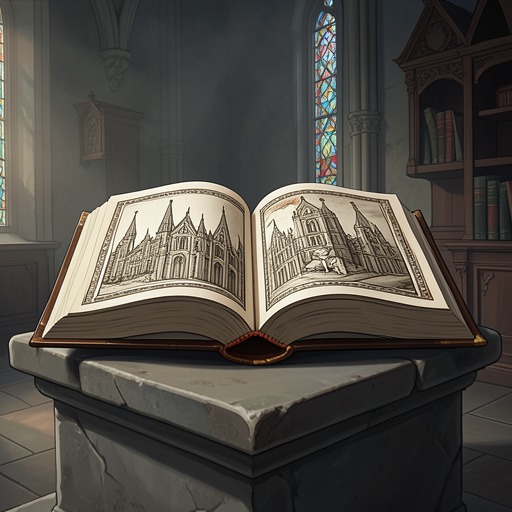
Medieval architecture as cultural memory
The Hunchback of Notre DameMedieval architecture as cultural memory is the novel’s account of buildings as records made by whole societies: they preserve artistic practice, political conflict, religious belief, and the work of generations in material form. Yet this memory is vulnerable. Inscriptions are erased, buildings are altered or destroyed, and each loss makes the past harder to recover. The book itself takes shape as a witness to what the stones can no longer say, turning description into an act of preservation.
Buildings as Records of Collective Life
The idea begins with a word deeply carved into the wall of Notre-Dame Cathedral. The author reflects on the unknown person who left this mark and on its melancholy significance; then the inscription is whitewashed or scraped away. The loss is not exceptional. Priests, archdeacons, and the populace all participate in different kinds of damage to medieval churches. The word disappears, its writer has vanished from human memory, and the church itself is imagined as liable to disappear. Against that sequence of erasures, the book dedicates its own fragile remembrance to the word and makes the lost inscription a foundation for the narrative.
The building’s meaning, in this view, exceeds the intention of any one maker. The façade of Notre-Dame Cathedral is described as a complex whole: three portals, twenty-eight royal niches, a great central rose window and two smaller windows, a gallery of trefoil arches, and two massive towers rise in an ordered arrangement of carving and sculpture. The result is compared to a vast symphony in stone, produced by the combined forces of an age. Individual workers’ inventions appear within a composition shaped by larger artistic discipline; the cathedral therefore holds both particular acts of making and a collective cultural achievement.
The novel extends this principle beyond the cathedral. Medieval churches across Christendom are presented as coherent works in which their parts belong to a self-created, logical, and proportioned art. Architecture becomes a kind of historical writing because the whole contains evidence of the society that made it: its craft, artistic conventions, and shared forms of belief. Reading a building closely can therefore reveal something larger than the isolated detail under examination.
Style, Change, and Historical Loss
The term Gothic is acknowledged as historically unsuitable in its common usage, but too established to discard. In the novel’s explanation, it names the architecture of the second half of the Middle Ages, associated with the pointed arch and succeeding an earlier period characterized by the semicircle. The terminology itself records how later readers classify the past, while the buildings preserve the visible transitions that such labels attempt to describe.
Those transitions remain legible in the architecture of Place de Grève. Its buildings range across forms dating from the fifteenth century back to the eleventh: the casement is shown displacing the arch, while the Roman semicircle survives beneath the pointed arch in the lower story of an old house. Even the arrangement of the city’s façades carries historical information. Houses once presented their gables toward streets and squares; over the following two centuries, they were turned around. A change in the ordinary orientation of buildings thus alters the appearance through which the city’s past can be perceived.
The novel’s account of the old Palais de Justice makes the fragility of this architectural record especially stark. A fire in 1618, followed by successive restorations, left very little of the former royal dwelling and its Grand Hall. The narrator offers a chain of possible causes involving Ravaillac’s assassination of Henri IV and the destruction of trial documents, but qualifies that explanation and notes other proposed accounts. The fire itself is certain; its precise explanation is not. The distinction matters: historical memory must preserve not only what remains known, but also the uncertainty surrounding what has been lost.
The catalogue of vanished features gives that loss particular weight. Chambers associated with Saint Louis, the Emperor Sigismond, Charles IV, and Jean the Landless are recalled alongside a staircase, a slab linked to political violence, a wicket connected to papal bulls, the gilded Grand Hall, a stone lion, stained glass, chased ironwork, and delicate woodwork. The replacements, in the narrator’s judgment, cannot restore what was destroyed: architectural remains carry historical associations that later construction cannot simply reproduce. The surviving great pillar retains only a diminished echo of the old site’s history.
The City’s Institutions in Stone
Place de Grève is not presented as scenery alone. Its irregular trapezoid, bordered by the quay on one side and narrow, gloomy houses on the other three, gathers domestic architecture from different periods into a single urban space. At its eastern side stood a hybrid building with three names, each preserving a different part of its history: the House of the Dauphin recalled Charles V’s residence there as Dauphin; the Marchandise recalled its use as the town hall; and the Pillared House described its construction. The building’s chapel, hearing room, and attic arsenal materialized the city’s religious, civic, and defensive functions under one roof.
The square also preserves a darker civic memory. A permanent gibbet and pillory stood together at its center, making the place an emblem of public punishment as well as urban life. The novel connects the site’s sinister reputation to the suffering enacted there and to the fear associated with the scaffold. Architecture and location do not merely retain an abstract past: their uses attach consequences, institutions, and human pain to particular spaces.
Notre-Dame as Image, Text, and Living Space
Notre-Dame Cathedral carries memory not only through its structure but through the interpretations of its sculptures. Claude Frollo studies the symbolic portal as though it were a page in a book of hidden knowledge. He contemplates the wise and foolish virgins, examines a raven on the façade, and searches for an encoded reference to the philosopher’s stone. His attention makes the cathedral an object of learned inquiry, though the meanings he assigns to its details remain his interpretations rather than settled facts.
Claude Frollo’s approach contrasts with Quasimodo’s attachment to the same building. Quasimodo loves the cathedral for its beauty, size, and harmonies; Claude Frollo is drawn to its myths, meanings, and riddles. Their different forms of devotion show how a building can be at once a material environment and a field of interpretation. The stones are shared, but what they offer their observers is not identical.
Claude Frollo’s lessons make the metaphor explicit. He invites an older man to read carved figures and architectural signs, and describes stone letters and granite pages as a book to be deciphered. Elsewhere he interprets figures on the portal through alchemical learning, while an examined crucible proves to be useless for making gold and fit only for a modest domestic purpose. These episodes place the authority of interpretation under pressure: the building invites reading, but a reader’s confidence does not guarantee that every proposed meaning is sound.
The cathedral also remains an active setting for public ritual. When a condemned young woman is brought to its central portal, the doors open onto a dim nave hung in black, with distant candles, a silver cross against dark drapery, and chanting from within. The contrast between the bright square and the cavernous church turns architecture into part of the event’s meaning. Its space gathers the condemned, the watching crowd, and religious ceremony into one charged threshold.
The Novel as an Act of Preservation
The book repeatedly sets architectural endurance against architectural vulnerability. A building may outlast its makers, but it is not immune to alteration, neglect, fire, or deliberate damage. Even when a structure survives, successive changes can obscure the forms and histories it once held. The remaining turret at Place de Grève, already threatened by plaster and the encroachment of new houses, makes preservation an urgent rather than abstract concern.
The novel answers this instability through detailed description and historical recollection. Its account of Notre-Dame’s façade, the vanished palace, and the layered buildings of Place de Grève attempts to recover relationships among form, use, and memory before they disappear. Architecture becomes a cultural record precisely because it was made collectively and used across time; literature can bear witness to that record, but it also acknowledges the limits of witness. The lost inscription cannot be restored, and the old palace cannot be rebuilt by describing it. What the book can preserve is the knowledge that these things existed, the circumstances of their disappearance, and the meanings their surviving traces still invite readers to consider.